
Earthbound has copy protection?

When I first heard about it, I didn’t even know it was possible for a Super Nintendo game to do such things outside of region locking. Earthbound does multiple things to make sure you’re playing the game legitimately.

The first line of defense is not out of this world, it just makes sure you’re playing it in the correct region for your system.

Part two of the copy protection comes when the game checks for SRAM. Anything more than 8kb gets you trouble with this screen below.

Phew … two different and separate tiers of copy protection. That’s got to be enough! Wrong! If any of the above features are disabled, the game will eventually notice that the programming has been changed and increase the number enemy encounters in numerous areas! This is sure to make a playthrough harder and much more frustrating.
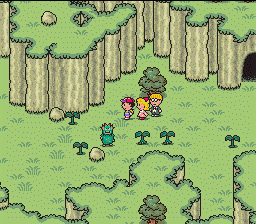
The little green sprouts and the dinosaur looking thing are the enemies

If that’s not enough to thwart potential pirates, the programming within Earthbound supposedly also checks multiple times while you’re playing, so parts one and two could possibly be implemented at any time. If the third zone of protection isn’t enough to scare you away, there is one last trick the game will pull.

After you finish the final battle, the game will freeze just before the ending. Upon resetting, you will find all your save games erased. The video below details the steps of Earthbound’s copy protection as well as the final tier in action.

Remembering: Donkey Kong Country (SNES)

https://i0.wp.com/upload.wikimedia.org/wikipedia/en/c/c1/Dkc_snes_boxart.jpg

Donkey Kong Country is a 2D sidescrolling classic. It’s a solid platformer and deserves its high praise. Developed by Rare in 1994, DKC entertained me for hours and was one of the first games I ever saw to 100% completion, or in this case, 101%.

I remember the first time I reached King K. Rool (the game’s final boss). My hands were sweaty and my mind was racing with excitement. At my young age, it wasn’t often that I got to beat a game. It took me countless hours to get there and I could already see the ending in my head. However, DKC was clever in tricking you towards the very end, giving you two parts to the final boss. After finally defeating him, you are rewarded with your infinite supply of bananas that was stolen.

There is a fine line between outright frustrating game design and frustrating elements of game design meant to challenge the player. Donkey Kong Country provides the latter: lots of aggravating moments and obstacles that seem impossible but can be resolved with skill or just dumb luck.

Back then the length and challenge of the game seemed longer and harder, playing it again definitely seems much shorter and a lot easier. I was able to breeze through it in a couple of hours. It is not perfect but, has plenty going for it. Donkey Kong Country’s music still rings in my head from time to time, the melodies and tunes are very well composed. And there are somethings you can’t forget after playing this for hours on end like the location of the bonus stages that gave you the most trouble.

The game was also released on the Game Boy Color (which I also played some time after beating the SNES version) and the Game Boy Advance.

Little things to recall …

  • The “3D” graphics and the first time you saw it
  • A video tape revealing DKC …
  • Favoring one character over the other
  • BARRAL for 50 lives!
  • The easy way to beat Stop & Go Station